education
A place to hash out all opinions on education policy, charter schools, statewide testing, and what the political world is and isn't doing about it.
U.S. strategic competition with China.
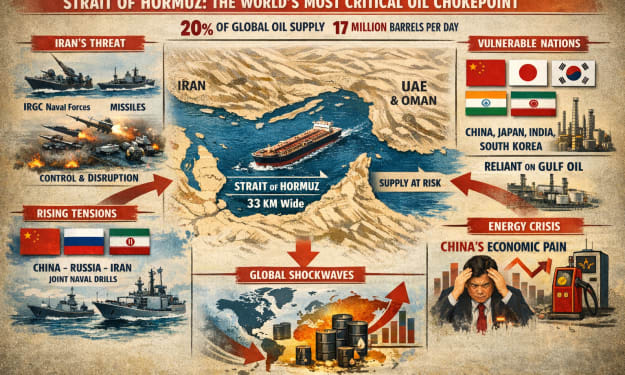
This war Stop being a medley story the moment the first oil tanker changed course in the Persian Gulf. What I mean is, Strait of Hormuz is the most important energy bottleneck on earth. Everybody knows it is the most important energy bottleneck on earth. And if it was the threat from Iran last time, this time Iran has partially done it. It is so narrow, IRGC has a lot of control over it. Just like in the Strait of Malacca, army/navy has control over it. Similarly, here the Iranians have control over it. And recently, China, Russia, and Iran have already conducted war games. So it is this narrow, 33 kilometers wide, you are hearing about it everywhere, everybody is talking about it. It is the width of a large city. So in this narrow passage, which holds 20% of the world's oil, one fifth of the world's oil and gas goes through, it is around 17 million barrels per day. There is no realistic alternative route except the Strait of Hormuz. If we close this passage, its consequences will not stop at any one border. Europe will pay, Japan will pay, India, South Korea, China, everybody pays the price. So a theory is floating around, which backs my argument that China is the target. It is that in Washington circles, there is a discussion going on, let's be honest, if this happens, what do we have to do? The hawkish people there say that this disruption should be allowed because it does not impact them as much as it impacts those countries, which I have just mentioned. So let's take this opportunity that the slowdown of China's energy supply can be slowed down. Trap Beijing in such an expensive moment as long as this congestion remains in the Strait of Hormuz, it remains closed, partially or completely. Iran keeps Beijing hit very badly from an energy security point of view. So the containment policy of China that is already going on is an added bonus. So imagine, on one hand, you are doing everything with technology and trade, imposing tariffs, treating them in the South China Sea, imagine all this. And from the other side, almost 90% of the oil and gas supplies go to China. If it is blocked for a few days, how badly it will hit China. So imagine, while the world is suffering, they are only having strategic designs in their minds.
By Ibrahim Shah 8 days ago in The Swamp
U.S. National Security Strategy (General Framework)
Here’s an overview of the United States’ national security policy and strategy toward Pakistan, Greenland, and Venezuela under the current (2025-26) administration — based on official strategy documents and reporting on major developments.
By Ibrahim Shah 17 days ago in The Swamp
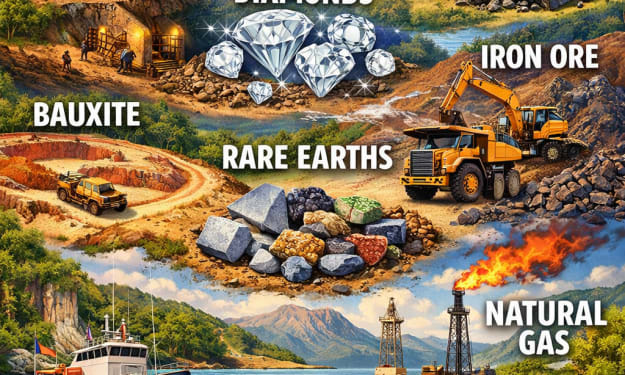
What resources does Venezuela have — apart from the world’s most oil?
Largest known oil reserves Venezuela has the world’s largest proven oil reserves, estimated at 303 billion barrels as of 2023, more than five times the amount the United States has, which is 55.25 billion barrels.
By Ibrahim Shah 18 days ago in The Swamp
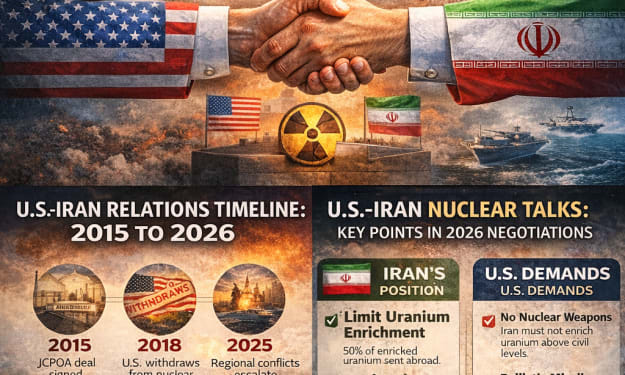
U.S.–Iran Relations in 2026: Nuclear Negotiations, Tensions, and a World on Edge
The Context: A Long History of Tension Relations between the United States and Iran have been fraught since the 1979 Islamic Revolution, when the U.S.-backed shah was overthrown and American diplomats were held hostage for 444 days. Decades of mistrust followed, marked by sanctions, proxy conflicts, and sharply diverging regional priorities.
By shahkar jalal18 days ago in The Swamp