technology
Talking tech; debates about regulating technology, privacy laws, piracy, and the pitfalls of AI.
Reimagining Matter’: Nobel Laureate Invents Machine That Harvests Water From Dry Air. AI-Generated.
A groundbreaking new water-harvesting technology developed by Nobel Prize-winning chemist Omar Yaghi has the potential to transform access to clean water in the world’s driest and most disaster-affected regions. The device — capable of extracting moisture from even extremely arid air — could provide a sustainable source of fresh water without reliance on centralized infrastructure, offering hope amid worsening global water scarcity. � The Asian Age A New Frontier in Water Technology Yaghi, a professor of chemistry at the University of California, Berkeley and recipient of the 2025 Nobel Prize in Chemistry, unveiled the invention this month, describing it as a “science capable of reimagining matter.” The system uses advanced materials designed at the molecular level to capture atmospheric moisture and convert it into potable water, even in conditions where traditional technologies struggle. Unlike conventional atmospheric water systems — which often require high humidity or significant electrical input — Yaghi’s technology operates using ultra-low-grade thermal energy. The units can be powered by ambient heat or residual thermal sources, eliminating the need for a constant electricity supply and allowing deployment in regions without established power grids. Designed to resemble a 20-foot shipping container, the systems can produce up to 1,000 litres of clean water per day, according to company estimates. That volume could sustain a small community or serve as a lifeline in emergency scenarios where infrastructure has been disrupted by natural disasters or climate extremes. From Desert Roots to Global Impact Yaghi’s personal history underscores the invention’s significance. Growing up in a refugee community in Jordan, he experienced firsthand the hardships of life without reliable access to water or electricity — a memory he recounted at his Nobel banquet speech. That early struggle, he said, helped shape his determination to solve one of the most pressing challenges of the 21st century: water scarcity. “In many places where I grew up, water was a precious and unpredictable resource,” Yaghi said. “This invention aims to make clean water more accessible and to reduce dependency on fragile supply networks that are vulnerable to drought and disaster.” The Asian Age Real-World Applications and Humanitarian Promise Experts emphasize that the technology’s potential extends beyond technical novelty. In areas devastated by hurricanes, droughts, or economic instability, water supply often becomes one of the earliest and most severe crises. In the Caribbean, where Hurricane Beryl and other storms have repeatedly damaged infrastructure, officials say the water harvester could offer a lifeline. Davon Baker, a government official and environmentalist from Carriacou and Petite Martinique, described the system as a promising tool for resilience and recovery. “We’re still dealing with the legacy of hurricanes — storms that knocked out centralized systems and left communities reliant on imported water,” he said. “A decentralized solution that produces water from air itself could help us adapt to a future of more intense weather events.” The invention also arrives amid alarming global statistics. A recent United Nations report described the world as entering an era of “global water bankruptcy,” with roughly 75% of the global population living in water-insecure conditions. Around 2.2 billion people still lack access to safely managed drinking water, and billions more experience severe scarcity for periods each year, the report said. Sustainability and Climate Adaptation Unlike some existing solutions such as desalination — which can harm marine ecosystems through concentrated brine discharge — Yaghi’s approach is engineered to be environmentally friendly. By leveraging ambient thermal energy and avoiding intensive electrical loads, the system aims to reduce carbon emissions and minimize ecological impacts. “This technology does not require mega-infrastructure or heavy energy investment,” said a sustainable technology expert. “That sets it apart from traditional freshwater sources and makes it especially suited for vulnerable regions facing compound climate risks.” However, many scientists caution that scaling the technology will require sustained investment, careful field testing, and adaptation to diverse climates. Large-scale deployment in extremely dry environments — where water vapor is sparse — presents engineering challenges that researchers will continue to evaluate. Looking Ahead With prototype units already in development, Yaghi and his team are working with partners to conduct pilot programs in regions most in need. The goal is to demonstrate operational viability and to refine how the systems can be integrated into community water strategies. As climate change intensifies droughts and strains water resources around the world, innovations like Yaghi’s atmospheric water harvester provide a promising glimpse of how science might help mitigate one of the planet’s most urgent challenges. Whether in disaster zones, arid regions, or underserved rural areas, capturing water straight out of the air may soon become a critical tool in building climate-resilient communities.
By Fiaz Ahmed 20 days ago in The Swamp
China Showcases Humanoid Martial Arts Robots: Should Europe Be Worried?. AI-Generated.
The world recently watched in awe as China unveiled humanoid robots capable of performing martial arts routines with striking precision and agility. These machines delivered choreographed kicks, punches, and complex stances that looked straight out of a science-fiction film. What once seemed futuristic fantasy is now an engineering reality—and it has sparked a wave of debate across the globe.
By Sajida Sikandar20 days ago in The Swamp
Grail Stock Craters as Key NHS-Galleri Cancer Blood Test Trial Fails to Hit Primary Endpoint. AI-Generated.
The promise of a simple blood test that can detect dozens of cancers early has captured the imagination of scientists, investors, and healthcare systems worldwide. But this week, that vision took a serious hit when Grail revealed disappointing results from its highly anticipated NHS-Galleri clinical trial.
By Sajida Sikandar20 days ago in The Swamp
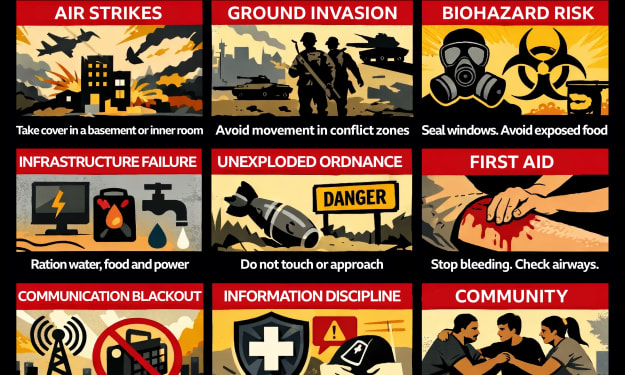
How to survive an attack by a world superpower. Content Warning.
This article provides practical measures for civilians facing severe, multi-domain attacks which might include: Sustained aerial bombardment Ground force incursions Naval or amphibious operations Release of biological or toxic agents Psychological and information warfare Extended disruption of society and infrastructure
By Addison Alder21 days ago in The Swamp
The Protection-of-Innocence Reciprocity Doctrine. AI-Generated.
Core Moral Premise The highest duty of any legitimate social order is the protection of innocent life. Innocent life has absolute moral primacy. Any system that systematically insulates predators, tolerates predatory asymmetry, rewards hypocrisy, or allows aggressors to retain insulation has inverted its purpose and forfeited legitimacy. Truth, justice, reciprocity, humility, mercy, forgiveness, and vertical accountability are structural necessities rather than optional virtues. Vertical accountability means recognition of and submission to a moral law higher than oneself. Authority must flow toward those who most consistently demonstrate sustained competence in moral and epistemic discipline. This competence is shown through observable conduct and trajectory over time, not through doctrinal label, tribal identity, credential alone, or self-profession.
By Peter Thwing - Host of the FST Podcast21 days ago in The Swamp
Three Silicon Valley engineers charged with stealing Google trade secrets and sending data to Iran. AI-Generated.
Federal prosecutors in the United States have unsealed an indictment charging three Silicon Valley engineers with allegedly stealing confidential trade secrets from Google and other technology firms and transferring sensitive data to Iran, officials said Thursday. The case has sparked concerns about insider threats to U.S. technology leadership, espionage risks and the safeguarding of proprietary innovations that underpin national economic and security interests. Allegations and Charges A federal grand jury in the Northern District of California indicted the three defendants — Samaneh Ghandali, 41; her sister Soroor Ghandali, 32; and Samaneh’s husband, Mohammadjavad “Mohammad” Khosravi, 40 — on multiple charges, including conspiracy to commit trade secret theft, actual and attempted theft of trade secrets, and obstruction of justice. All three reside in San Jose and were arrested on February 19, 2026 before appearing in federal court. Prosecutors allege that the trio exploited their employment at major Silicon Valley technology companies to access and exfiltrate hundreds of confidential files. These files included proprietary information related to mobile processor security, cryptography and advanced semiconductor technologies, which play crucial roles in the performance and security of modern devices. Insider Access and Exfiltration According to the indictment, both Samaneh and Soroor Ghandali previously worked at Google before moving to another firm referred to in court filings as “Company 3.” Khosravi was employed at a separate company identified as “Company 2,” where he worked on similar technologies. Federal prosecutors say that the defendants used their positions to collect and transfer sensitive material to unauthorized locations — including personal devices, shared work devices and third-party communications platforms — before some of the information was ultimately accessed in Iran. Google’s internal security systems reportedly flagged suspicious activity by Samaneh Ghandali in August 2023, leading to the revocation of her access to sensitive systems. Despite this, prosecutors allege that the group continued covertly obtaining and copying information, taking deliberate steps to conceal their actions. Efforts to Avoid Detection Federal authorities contend that the defendants engaged in extensive efforts to evade detection. After her access was revoked, Samaneh Ghandali signed a sworn affidavit falsely denying that she had shared proprietary information outside the company. Subsequent online searches from devices linked to the couple included queries about how long mobile carriers retain messages and how to delete communications — searches prosecutors say were attempts to disable forensic traces of their activity. When electronic uploads risked detection, the indictment alleges that the pair resorted to manually photographing computer screens displaying sensitive data, including trade secrets related to system-on-chip (SoC) designs used in advanced semiconductor processors. On the eve of a December 2023 trip to Iran, Samaneh allegedly captured dozens of these photographs on her husband’s work device. While in Iran, prosecutors allege, a personal device linked to Samaneh accessed the images, and Khosravi used another device to continue accessing confidential material. Security and Espionage Concerns FBI Special Agent in Charge Sanjay Virmani described the alleged conduct as a “calculated betrayal of trust,” highlighting the gravity of insiders abusing privileged access to extract sensitive intellectual property. He noted that safeguarding U.S. innovation and protecting technologies that contribute to national competitiveness is a “top priority” for federal law enforcement. From a broader perspective, cybersecurity experts have increasingly warned that insider threats, particularly those exploiting legitimate access under the guise of professional roles, remain among the most difficult challenges for corporate and national security. The theft and unauthorized transfer of trade secrets — especially to foreign jurisdictions — raises concerns about economic espionage, unfair competitive advantage and erosion of technological leadership. Government and Corporate Responses In response to the incident, Google issued a statement underscoring its commitment to protecting confidential information. Company representatives said the breach was detected through routine monitoring procedures and that Google immediately alerted law enforcement once the activity was discovered. They also emphasised ongoing enhancements to internal safeguards designed to limit unauthorized access and flag anomalous behavior. Federal prosecutors said the case is being handled by the National Security and Special Prosecutions Section of the U.S. Attorney’s Office for the Northern District of California, reflecting the serious intersection of intellectual property theft with national security interests. Penalties and Legal Outlook The defendants are presumed innocent unless proven guilty in court. If convicted on all counts, each faces substantial penalties: up to 10 years in prison for each trade secret theft count, up to 20 years on the obstruction charge, and fines of up to $250,000 per count. These maximum sentences reflect the severe legal exposure associated with trade secret theft and obstruction of justice in U.S. law. Legal experts say the indictment signals continued federal resolve to prosecute sophisticated cases involving corporate insiders and the unauthorized dissemination of cutting-edge technological information — particularly where alleged transfers may benefit foreign interests.
By Fiaz Ahmed 21 days ago in The Swamp