Annie Kapur
Bio
I am:
🙋🏽♀️ Annie
📚 Avid Reader
📝 Reviewer and Commentator
🎓 Post-Grad Millennial (M.A)
***
I have:
📖 300K+ reads on Vocal
🫶🏼 Love for reading & research
🦋/X @AnnieWithBooks
***
🏡 UK


Stories (2866)
Filter by community
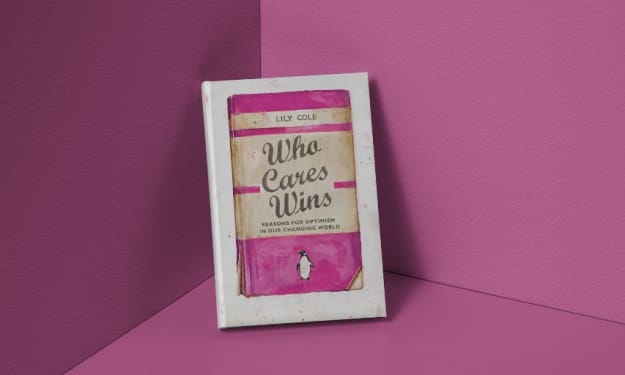
Book Review: “Who Cares Wins” by Lily Cole
Lily Cole is perhaps known more for her work on screen than in literature. A model, an actress and a filmmaker, Lily Cole has explored a wide range of her talents throughout the media industry and continues to expand to this day. Her book “Who Cares Wins” is all about our own problems today but, different to other books of its kind it does not depict it as an apocalyptic nightmare to bring down the reader into a deep hole of eco-depression. Instead, Lily Cole’s book seeks to show us that there are interesting and vast ways to solve these problems if we care enough and if we concentrate on what really matters. Her skills at showing us massive problems with our own world and then telling us that we have the solution to them at our fingertips if we work together is something that I find incredibly interesting about this text. The optimism and the clarity in writing style really make you want to stick through the book and read what she has to say. Why? Well, it is the only real book you’ll find about the environment that does not lead to the end of the world.
By Annie Kapur6 years ago in Motivation
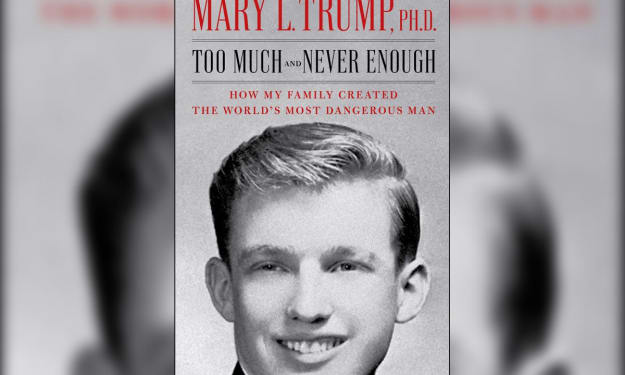
Book Review: “Too Much and Never Enough” by Mary L. Trump
Initially, I was a bit apprehensive about reading this book, and I’ll tell you exactly why. Nearly everyone has tried to explain the dystopian apocalyptic nightmare that is the reign of Donald Trump as POTUS, even those who initially supported him during his 2016 election campaign. Since the mass movements that have developed during his presidency, the environmental crises, the Flint Water problems and many more, Donald Trump is more inactive than evil - even his Twitter account is more alive than his want to remove the dark stains that protrude through American History and are seemingly slipping through the cracks in his power once again. Again, everyone has written a book or thought about writing a book about why they cannot really understand how Donald Trump is still president through all of this, but I was more apprehensive about reading this particular one not because it was by his niece but because it was dealing with something that from research, I know to be a touchy subject: Donald Trump’s mental health.
By Annie Kapur6 years ago in The Swamp
Book Review: “Shuggie Bain” by Douglas Stuart
“Shuggie Bain” by Douglas Stuart is a book about the kind of life we rarely read about in literature. It’s about the lives of those trying desperately to make ends meet in the bustling life of inner-city Glasgow. Set between the years of the early 1980s and the early 1990s, this book gives us a reason to read it. It doesn’t invite us to experience the life that Shuggie is living, but instead allows us to immerse ourselves in it, feeling what he is feeling and going where he is going. We are given an apt look at his life, starting with the man we meet working at the supermarket and then, moving back over to his childhood and more importantly, his relationship with his mother. This book is a hand in teaching us that we don’t know the lives of others upon first glance. They could be anyone, serving you in the supermarket, making your coffee at the cafe or even serving you at the checkout - we have no right to judge others without truly walking in their shoes and feeling what they are feeling. This book is a brilliantly polished example of that in practice.
By Annie Kapur6 years ago in Geeks
“The Wise Woman” by Philippa Gregory
I first read this book when I was fifteen years’ old and in school. I couldn’t really tell anyone that I was a Philippa Gregory fan because of two things: the first thing is that I didn’t really go to school with other children that liked to read - they were more into hair, nails etc. and the second reason is that I wasn’t very popular anyway so I wouldn’t have had anyone to tell anyway. “The Wise Woman” wasn’t the first Philippa Gregory book I read but it was definitely one of my favourites because there was a big theme of vengeance and I love it when characters take revenge on people who were not very nice to them.
By Annie Kapur6 years ago in Geeks
Book Review: “Throw Me to the Wolves” by Patrick McGuinness
This thriller novel may be original, yes, but there are many improvements if we want to move to the ‘groundbreaking’ realm. There are a number of improvements this novel can make, but in my opinion I have to say that the book itself is mostly well written. It does the job of making a novel entertaining to read - but when we come to deeper thought things can get a bit sticky. For example: the first few chapters of the novel up to the first encounter with the young “Danny and Ander” are incredible in terms of deep philosophy to do with estuaries and memories, everything from existential crises of great solitude to wanting to be right there, jumping to your death. When it comes to the first encounter of Danny and Ander however, I feel like the book actually falls a bit flat. As if the author is no longer using those mediums of lengthy description and internalised metaphors. These great wordings and speeches of introspection that were felt before seem to vanish. I understand that Ander is supposed to be younger and therefore, not really into thinking about such things, but seriously - it is like the writing style changes entirely. From the chapters on Gary and the investigation to the chapters on Danny and Ander - I think there is a stark difference in writing which makes the reader more and more distant from Danny and Ander and makes us less likely to care until the unthinkable actually happens.
By Annie Kapur6 years ago in Geeks
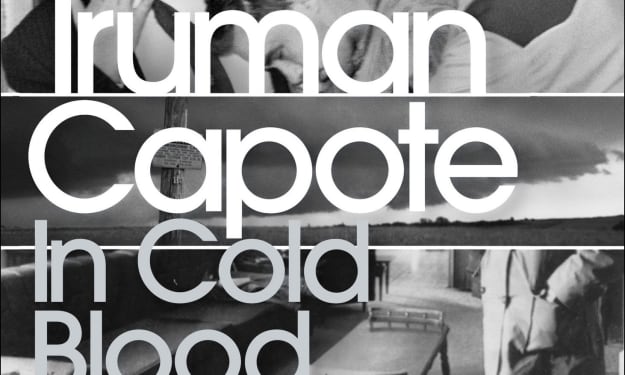
"In Cold Blood" by Truman Capote
I first read this book when I was about fifteen years’ old and it was because I had seen it in the local library but it was a tattered copy and so, I bought my own - intact. From not even opening the book, I felt like this was an important text. I wrote the following about it in my diary even before actually reading the book: “there’s something strange about this book. It’s as if it is asking me not to read it but it’s pulling me in. Something about the phrase ‘in cold blood’ sounds unnerving and dangerous. I’ve heard a bit about it but I was never sure to rely on other people’s verdicts of novels. Apparently though, according to some people - this isn’t really a novel at all. Then what is it?” That was the question I had asked: “What is it?” It isn’t really a novel because it isn’t really fiction and, as I know after many re-reads over the years, it isn’t entirely accurate either and so, it isn’t a non-fiction novel. It is an embellishment of the truth for the sake of entertainment and so, it is half and half, something that humans have been doing for centuries. Yet, it is entirely new. It is the new, modern version of criminal justice novels. It was true-crime and this is where I had first encountered a book of which the entire genre would come to change everything about what I believed literature could be. I would be obsessing over true crime for near a decade afterwards and it would be because of “In Cold Blood”. The first question you always ask yourself when you read “In Cold Blood” for the first time and that was the same question I asked myself when I finished the book. I wrote in my diary: “This was a strange book, I’ve never really read anything like it. The moment I finished it, I just sat there thinking about the same question over and over again - ‘what happens if it’s all entirely true?’”
By Annie Kapur6 years ago in Criminal
Book Review: “Bland Fanatics” by Pankaj Mishra
Pankaj Mishra’s book “Bland Fanatics” is basically our answer to Edward Said’s “Orientalism” - well, at least the first few essays are. Often presented as overtly pretentiously worded articles, Mishra actually fails on the key points of his argument, often skirting around the issue and addressing things that are possibly less important. However, there are things that I agree with when he does make a point and certainly, there are important arguments to be had here - I am just wondering whether Mishra has his own priorities, considering his political sway, a little bit mixed up for the time being. Sentences and paragraphs inside Mishra’s essays are often overly word-heavy and require to be broken down to understand them, which is something else I take issue with. Mixed within political jargon and inaccessible writing, Mishra has managed to create a barrier between himself and the common reader who possibly did not go to university or has not got the education required to understand the ins and outs of politics in the modern world. The real question here is: does Mishra fail to actually enforce his point as he commits himself to word-heavy sentences and paragraphs? Is this entire book just one big irony?
By Annie Kapur6 years ago in Geeks
"The Cask of Amontillado" by Edgar Allan Poe
I first read this story when I was a younger child because I used to have some tapes of the stories of Edgar Allan Poe read by the likes of Vincent Price and Christopher Lee (yes, I was a fairly odd child). Oh, and when I say ‘child’, I mean about nine years’ old, or roundabout that age. I used to play these tapes on my radio and cassette player and well, they scared the absolute crap out of me. After a while, as I grew up, I got these ‘tapes’ on a digital file and managed to put them on an MP3 player that plugged into my desktop computer. I no longer had to wind my cassette tapes with a pencil just to listen to scary accents reading my favourite gothic stories. The one story that always terrified me though was “The Cask of Amontillado” - it wasn’t “The Raven” or “The Pit and the Pendulum” and no, it wasn’t “Tell Tale Heart” or “The Murders in the Rue Morgue” - it was always “The Cask of Amontillado”.
By Annie Kapur6 years ago in Geeks
"The Hours" by Michael Cunningham
I did not get around to reading this until I was twenty-two years’ old and yet, it was a great book and I found the experience almost overwhelming. I was actually reading it for university and because I had to, but for some years before - one of my friends had been recommending it to me for an awfully long time and I had not actually read it off their recommendation (I’m pretty sure that annoyed her, but at least I eventually read it!). When I first read it, I was sitting bored out of my mind in a class on historical theories of western philosophy and someone was talking about Schopenhauer to which I thought ‘what is the point? we are all just going to die anyway…’ (laughs in Schopenhauer). Unfortunately enough, I’d already read the text on western philosophy that we were studying some years before and so, I began a new text, zoned out and thanked god that there were a lot of other students in the class. “The Hours” by Michael Cunningham was one of the greatest and most beautifully post-modern books I’d read since “Cloud Atlas” by David Mitchell.All about the great influence of Virginia Woolf on the lives after and considerably similar to her own, this book covers the lives of three women that are about to become intertwined only in their own experiences of womanhood, grief, goodness and their want to be more than themselves. I was fascinated by the language and even though I wasn’t a huge fan of the movie, I was definitely a huge fan of the book that was written like a symphony. It is truly a masterpiece of post-modern fiction. My first reading experience at twenty-two was well worth it and I often thank god that I left it for as long as I did. I thoroughly believe in reading books at the right time in order to get the right experience and this was definitely one of those books you need to do that with. It has such incredible atmosphere, the characters are so thorough and beautiful and the way in which it is written has such incredible description. It is one of the best written books of the last twenty years and yet, not many people I know have actually read it. Even the other people on my course didn’t seem to bother. I have no idea why - it was an amazing book.
By Annie Kapur6 years ago in Geeks
Book Review: "How to Destroy America in Three Easy Steps" by Ben Shapiro
Ben Shapiro’s introduction to his new book “How to Destroy America in Three Easy Steps” begins with capturing the very depths of the free-thinking mind of the new generation of political libertarians, liberals and conservatives alike. He ignites conversation, question and rethinking with his incredible argument that America moves towards disengagement and misinformation. Shapiro proves to be back on top form with his book “The Right Side of History” being a massive success and, from a readers point of view whether you like him or not, you have to admit that he knows what he’s talking about. As America tries to uphold herself in her 250 year civil rights’ history since the war, Shapiro lets us all in on a secret: that we are the problem and yet, we are also the solution. His writing style is clear, concise and consistent with a man who proves that ethics and morals, standards and cultural traditions seem to arise over conflict, mass mob culture, labelling and chaos. As both the right and the left of the American Political slip into chaos, Ben Shapiro is there explaining why they are both completely wrong.
By Annie Kapur6 years ago in The Swamp
"Invitation to a Beheading" by Vladimir Nabokov
Often, people ask me what my favourite Nabokov novel is and I have to say that the one I have read that is most unlike his other works is possibly “Invitation to a Beheading” because it represents something that is familiar to us in his bibliography that is written in an entirely different way. We get the question of morality and happiness, the difference between right and wrong and then, we get it written in a style that is often described as “kafkaesque” though I beg to differ. I first read this book when I was sixteen years’ old and nearing the summer of my life before sixth form. It was a scorching hot day and reading Nabokov whilst drinking juice was often considered the high life of the teenage literary nerd. This book is about a man called Cincinnatus C. who is due to be executed and often, we experience the various morality filters of different characters, including guards, family members and the protagonist himself. The characters I always associated most with the morality question were the protagonist, Cincinnatus and a man called Pierre, who mostly plays the sort of almost villainous shadowy trait of humanity in which we do things we are not proud of but often do them anyway. Pierre seems to represent not only morality, but the obsession and want to do something good, but the decision to do what one wants instead. It’s almost very Nietzsche of him I think. This book is written in a style that often, I would not associate with Nabokov - it written almost exclusively in an omniscient style, but also with an aspect of trickery. It is like Nabokov is trying to trick us into an ending. Some may say that the ending is anti-climatic but I believe that it is often more philosophical than we first think and subsequent readings have shown me this.
By Annie Kapur6 years ago in Geeks
Book Review: “Chasing the Light” by Oliver Stone
As we are all probably well aware by now, Oliver Stone is one of my favourite directors ever with his film “JFK” (1991) being one of my favourite films of all time. He has directed amazing movies like “Any Given Sunday” and the legendary “Platoon” which is based on his own experiences as a soldier in the Vietnam War. But little do we know about what happened before all of this great directing. Oliver Stone lets us into his life in which there are many, many setbacks for him. His perseverance through broken relationships, both family and in love, failed odd jobs and many more left him without money and often without hope. But, this man still managed to find the time to write out scripts upon scripts which were rejected each and every time. Of course, there was no doubt that one day, he would write a script that would become a great movie as we read this book after a lengthy, successful career. Oliver Stone writes passionately about his experiences, with vigour, reality and does not seek to be anything he is not. He tells his story in words that all can understand and all will come to understand the story behind this legend which is one of constant kicks and punches. In the end though, he does not give up.
By Annie Kapur6 years ago in Geeks